
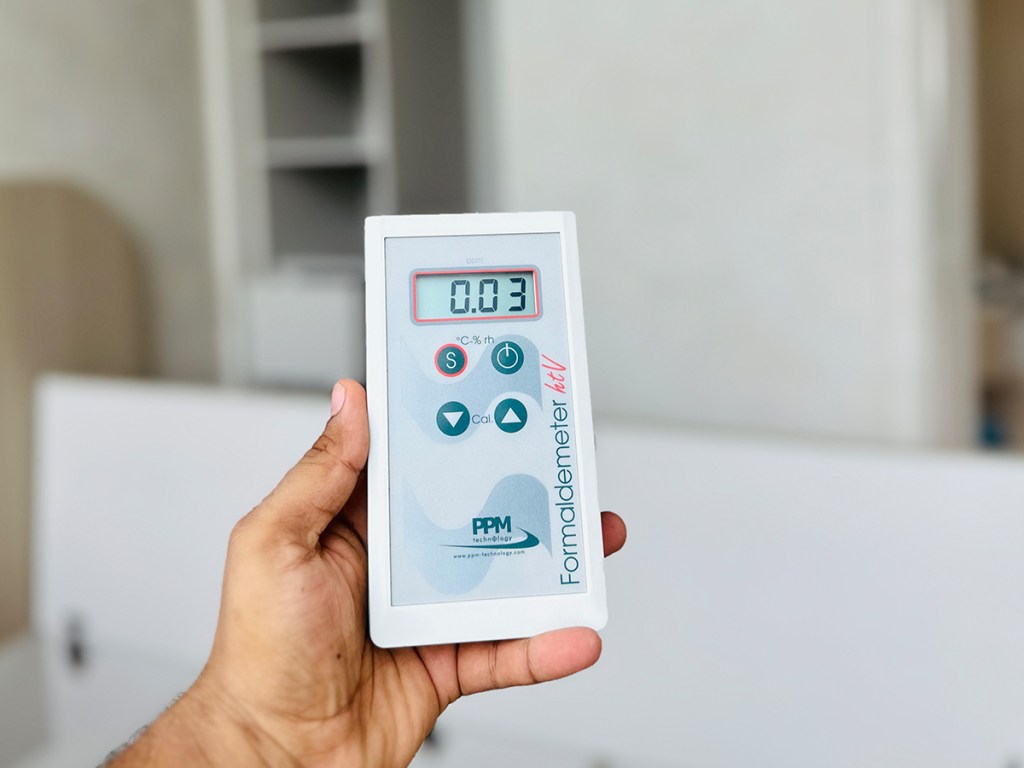
Formaldehyde is a key component in many construction materials and furnishings, making it a central concern in home renovation and building projects. Both the United States and Singapore have established formaldehyde regulations to protect public health and ensure safe indoor environments. However, the approaches differ in their scope, enforcement mechanisms, and stringency.
This blog post compares Singapore’s formaldehyde standards with those of the United States, focusing on their impact on home renovation and building. Understanding these differences can help homeowners and builders make informed decisions to create healthier indoor spaces.
Formaldehyde is a volatile organic compound (VOC) used in resins, adhesives, and coatings for construction materials like plywood, particleboard, and MDF. It is also present in certain paints, varnishes, and furnishings. During and after renovation, formaldehyde can off-gas into indoor air, leading to potential health risks such as:
Short-term effects: Eye, nose, and throat irritation, headaches, and skin sensitivity.
Long-term effects: Increased risk of respiratory illnesses and cancer, as classified by the International Agency for Research on Cancer (IARC).
Due to these risks, formaldehyde standards are critical in ensuring safe indoor air quality during and after renovations.
1. Indoor Air Quality (IAQ)
The United States does not have federal indoor air quality standards for formaldehyde. However, the Environmental Protection Agency (EPA) provides guidelines to limit long-term exposure:
Recommended Level: ≤ 0.016 ppm (16 µg/m³) for residential indoor air.
2. Building Materials
One of the strictest formaldehyde regulations globally is the California Air Resources Board (CARB) Phase 2 standard. This regulation limits formaldehyde emissions from composite wood products:
Limit: ≤ 0.05 ppm for materials like MDF, plywood, and particleboard.
The CARB Phase 2 standard is also adopted federally under the EPA TSCA Title VI rule, ensuring nationwide compliance.
3. Consumer Products
The regulation of formaldehyde in consumer goods, such as textiles and cosmetics, is overseen by:
FDA (Food and Drug Administration): Limits formaldehyde in cosmetics to ≤ 0.2% as a preservative.
CPSC (Consumer Product Safety Commission): Ensures safe levels of formaldehyde in furniture, mattresses, and other household items.
4. Workplace Safety
The Occupational Safety and Health Administration (OSHA) regulates formaldehyde exposure in workplaces:
TWA (Time-Weighted Average): ≤ 0.75 ppm over an 8-hour workday.
STEL (Short-Term Exposure Limit): ≤ 2 ppm for 15 minutes.

1. Indoor Air Quality Standards
Singapore regulates indoor air quality through SS 554:2016, which sets a formaldehyde limit of 0.1 mg/m³ for good indoor air quality. This standard aligns with WHO guidelines and applies to residential, commercial, and public buildings.
2. Building Materials
Singapore does not have unique formaldehyde emission classifications for building materials. Instead, the country adopts international standards such as:
E1 Class (Europe)
CARB Phase 2 (California Air Resources Board) from the United States.
Using compliant materials ensures safer indoor air quality during and after renovation.
3. Consumer Products
Singapore follows the ASEAN Cosmetics Directive, which limits formaldehyde use in products like cosmetics and adhesives. For textiles, Singapore adheres to international benchmarks, similar to those in Europe.
4. Workplace Safety
Under Singapore’s Workplace Safety and Health (WSH) Act, permissible exposure limits (PEL) for formaldehyde are:
TWA: 0.5 ppm.
STEL: 1 ppm.
1. Indoor Air Quality (IAQ)
United States: EPA recommends stricter limits for formaldehyde in indoor air (≤ 0.016 ppm) compared to Singapore’s 0.1 mg/m³ (equivalent to 0.1 ppm).
Singapore: Aligns with WHO guidelines but does not adopt stricter recommendations like the EPA’s.
2. Building Material Standards
United States: CARB Phase 2 limits formaldehyde emissions to ≤ 0.05 ppm, one of the most stringent standards globally.
Singapore: Relies on adopting CARB Phase 2 and other international standards but does not enforce unique classifications.
3. Workplace Safety
United States: OSHA’s TWA (≤ 0.75 ppm) and STEL (≤ 2 ppm) are more lenient than Singapore’s WSH Act limits (TWA ≤ 0.5 ppm, STEL ≤ 1 ppm).
Singapore: Enforces stricter occupational exposure limits to protect workers in industries with high formaldehyde use.
4. Consumer Products
United States: FDA and CPSC regulations provide detailed guidelines for formaldehyde in cosmetics, textiles, and furnishings.

The United States has stricter formaldehyde regulations compared to Singapore for several reasons. These include differences in regulatory frameworks, public health priorities, enforcement mechanisms, and consumer demands. Below are the main factors driving the U.S.’s stricter stance:
1. Stronger Consumer Advocacy and Awareness
2. Comprehensive Regulatory Frameworks
3. History of Health Concerns
4. State-Led Innovation
5. Stricter Occupational Safety Standards
6. Litigation and Legal Enforcement
7. Research and Technological Advancements
8. Public Health Prioritisation

1. Check Certifications
Always verify that materials and products meet formaldehyde emission standards. Look for labels like:
E1 for European compliance.
CARB Phase 2 for U.S.-aligned products.
2. Prioritise Ventilation
Ensure proper ventilation during and after renovations. Use air purifiers with activated carbon filters to reduce VOC levels.
3. Engage Professional Services
Consider hiring experts like Vinyl Guards for post-renovation deep cleaning and Home Guards for formaldehyde removal. These services are essential for achieving good indoor air quality.
4. Educate Yourself
Understand the risks associated with formaldehyde and advocate for safer materials during renovation planning. Engage with contractors who prioritise sustainable and low-emission products.

Both the United States and Singapore have robust formaldehyde standards to ensure public health and safe indoor environments. However, the U.S. leads in stricter material standards like CARB Phase 2 and detailed consumer protection frameworks, while Singapore aligns with international benchmarks to ensure compliance and safety.
For homeowners and builders, understanding these standards is critical to creating safe and compliant living spaces. By choosing certified low-emission materials, ensuring proper ventilation, and engaging professional cleaning services, homeowners in both countries can achieve healthier and more sustainable homes. Companies like Vinyl Guards/Home Guards play a crucial role in achieving these goals, promoting safer renovations and better indoor air quality.
Investing in safer practices not only protects your family’s health but also enhances the sustainability and value of your home. When planning your next renovation, prioritise your health and contact Home Guards via Whatsapp us at wa.me/6588361340.
Subscribe now to keep reading and get access to the full archive.